

The Role of Foam Stabilizers in Flexible Polyurethane Foam · An Introduction
In the previous two articles, we introduced two important components in flexible polyurethane foam: polyether polyols provide the foundation, while catalysts help control the reaction rate and balance.
This time, we turn to another important component — the silicone surfactant. Commonly referred to as “silicone oil” in the polyurethane industry, it does not generate gas or act as a conventional catalyst, yet it plays an important role in determining whether foam cells are fine or coarse, uniform or irregular, and open or closed.
In simple terms, catalysts help control the reaction process, while silicone surfactants help control the cell structure.
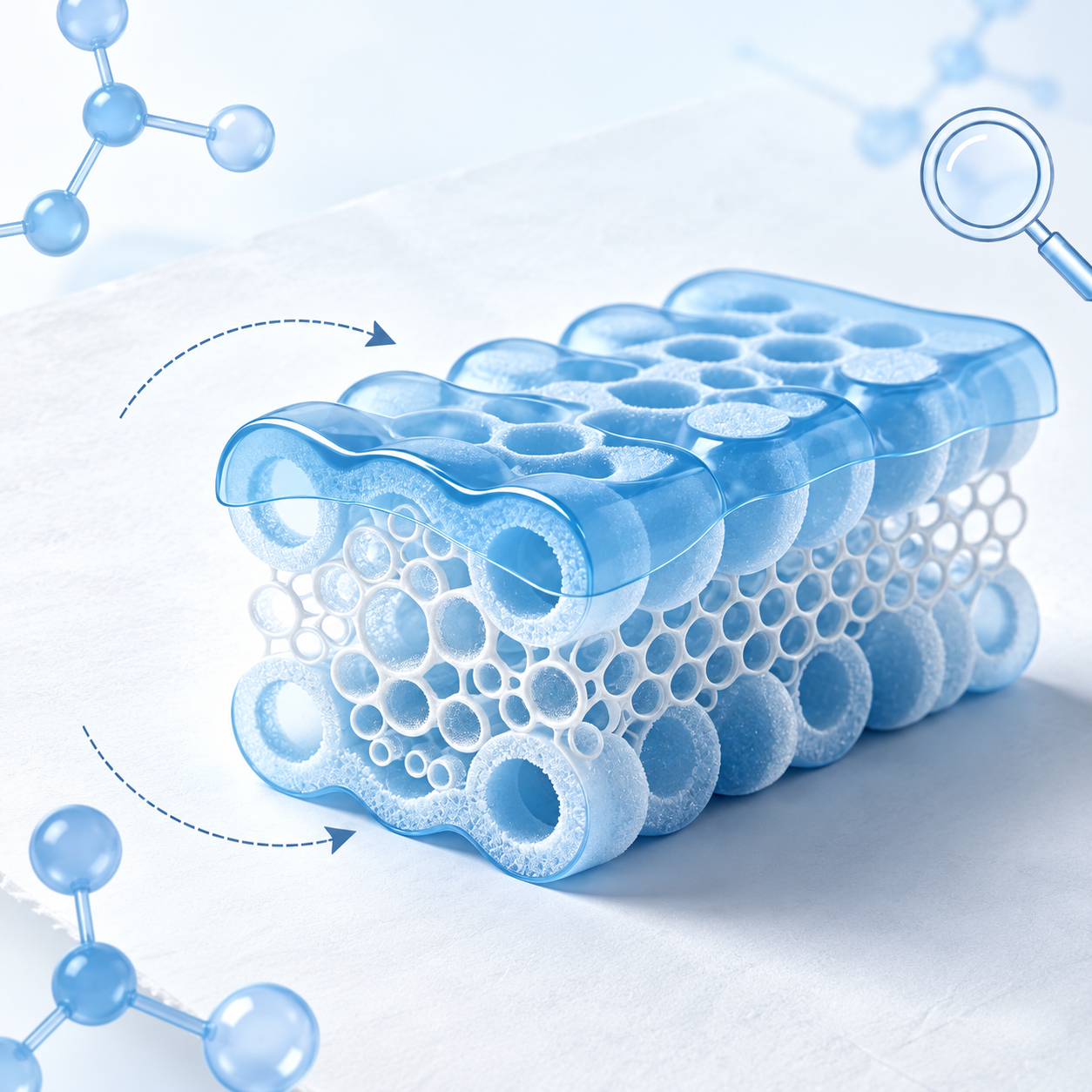
What Is a Silicone Surfactant?
The material commonly called “silicone oil” in flexible foam production is typically a polyether-modified polysiloxane, also referred to as a polyether-modified organosilicone surfactant.
Its main function is related to surface and interfacial behavior during the foaming process. By reducing surface tension, improving compatibility between formulation components, and stabilizing growing bubbles, the silicone surfactant helps the foam develop a finer and more uniform cellular structure.
Its functions can generally be summarized in three areas: reducing surface tension, improving emulsification and compatibility, and providing appropriate foam stabilization during cell formation and opening.
Is It the Same as Ordinary Silicone Oil?
Although the term “silicone oil” is widely used in the polyurethane industry, a flexible-foam silicone surfactant is not the same as ordinary polydimethylsiloxane (PDMS) silicone oil commonly used for lubrication or in many defoaming applications.
Flexible-foam silicone surfactants are generally polyether-modified polysiloxanes. Their molecular structure contains both siloxane and polyether segments.
The siloxane segment, based on the Si–O–Si structure, has low surface energy and tends to concentrate at interfaces, helping reduce surface tension. The polyether segment provides compatibility with the liquid polyurethane formulation.
The combination of these two segments gives the surfactant its characteristic interfacial activity and allows it to perform effectively during polyurethane foam formation.
Common Misunderstandings About Silicone Surfactants
One common misunderstanding is that a silicone surfactant is simply ordinary silicone oil. In fact, the two differ significantly in molecular structure and function. Conventional silicone oils designed for lubrication or defoaming cannot simply be substituted for polyurethane foam stabilizers.
Another misunderstanding is that increasing the amount of silicone surfactant will automatically make the foam softer or smoother. Silicone surfactants are primarily used to control interfacial behavior and cell structure rather than to determine foam softness directly.
The final feel and mechanical properties of flexible foam depend on many factors, including the polyol and isocyanate system, formulation balance, cell structure, processing conditions, and post-treatment. Therefore, increasing the silicone surfactant dosage alone does not necessarily improve the final foam.
1. Reducing Surface Tension and Refining Cell Structure
One of the main functions of a silicone surfactant is to reduce surface tension within the foaming system.
Lower surface tension reduces the energy barrier for bubble nucleation, making it easier for a larger number of smaller bubble nuclei to form. This generally contributes to a finer and more uniform cell structure.
When surfactant performance or dosage is insufficient, the foam may develop coarse cells, uneven cell sizes, cell coalescence, or other irregular cellular structures.
2. Improving Compatibility and Emulsification
A polyurethane foam formulation contains several components with different chemical characteristics, including polyether polyols, water, isocyanates, catalysts, and other additives.
These materials are not naturally compatible to the same degree. Silicone surfactants help improve dispersion and emulsification within the formulation, allowing the components to remain more uniformly distributed during mixing and reaction.
Better compatibility contributes to more consistent foam formation. Poor compatibility, on the other hand, may result in uneven dispersion, localized reaction differences, and irregular cell structures.
3. Stabilizing the Foam During Cell Growth
During the foam-rise stage, gas bubbles expand rapidly while the polymer structure is still developing. At this stage, the cell walls are relatively weak and require sufficient stabilization.
Silicone surfactants help stabilize the thin liquid films surrounding the growing bubbles. This reduces premature film rupture and excessive bubble coalescence before the polymer network has developed enough strength to support the foam.
If stabilization is insufficient during this stage, cells may merge or rupture too early, increasing the risk of coarse cells or foam collapse.
4. Supporting Controlled Cell Opening
Foam stabilization does not mean keeping every cell permanently closed.
As gelation progresses, the polyurethane framework gradually develops sufficient strength. At the appropriate stage, the thin windows between adjacent cells begin to rupture, contributing to the development of an open-cell structure.
This process is particularly important in flexible polyurethane foam, where an appropriate open-cell structure contributes to air permeability, dimensional stability, resilience, and other performance characteristics.
The balance is important. If the cell windows rupture too early, the foam may lose stability and collapse. If the foam remains excessively stabilized for too long, the structure may contain too many closed cells, which can contribute to shrinkage and other processing problems.
The Relationship Between Silicone Surfactants and Cell Opening
The influence of silicone surfactants on cell opening is more complex than simply “stabilizing first and releasing later.”
Certain silicone surfactants can influence the compatibility and phase behavior of polyurea-rich domains formed during the early stages of the reaction. These changes can affect the evolution of the cell windows as the foam structure develops.
Therefore, the objective is not to achieve the strongest possible stabilization. The objective is to achieve an appropriate balance between bubble stabilization, polymer development, and cell opening for a particular foam formulation.
Different foam systems may therefore require silicone surfactants with different structures and stabilization characteristics.
How to Understand the Role of Silicone Surfactants
The role of silicone surfactants in flexible polyurethane foam can be summarized in three main functions.
First, they reduce surface tension and help produce smaller, more uniform bubble nuclei. Second, they improve compatibility and dispersion among the different components in the formulation. Third, they stabilize the growing foam and help the cellular structure develop appropriately as gelation proceeds.
A simple way to distinguish the roles of catalysts and silicone surfactants is:
Catalysts mainly influence reaction rate and balance, while silicone surfactants mainly influence foam stabilization and cell structure.
However, these functions are interconnected. A foam defect cannot always be attributed to one component alone, and practical troubleshooting should consider the entire formulation and processing conditions.
What Happens When the Balance Is Wrong?
When the type or dosage of silicone surfactant is not suitable for the formulation, several processing problems may appear.
Insufficient stabilization may contribute to coarse cells, irregular cell size, cell coalescence, or foam collapse. Excessive or inappropriate stabilization may make cell opening more difficult and can contribute to excessive closed-cell content or shrinkage.
Similar symptoms can also be caused by catalyst imbalance, raw material variations, temperature, mixing conditions, or other formulation factors. For this reason, silicone surfactant selection should always be evaluated together with the complete foam system rather than as an isolated variable.
Summary
Silicone surfactants are important processing additives in flexible polyurethane foam. Although they are often called “silicone oil” in the industry, they are generally polyether-modified polysiloxanes designed specifically to control surface and interfacial behavior during foaming.
Their main functions are to reduce surface tension, improve compatibility and emulsification, stabilize growing bubbles, and support the development of an appropriate cell structure.
The key is not simply to provide more stabilization, but to achieve the right level of stabilization at the right stage of the foaming process.
Understanding this principle is the first step. In practical production, the next questions are more specific: What does insufficient silicone surfactant look like? What happens when the dosage is too high? How can silicone-related foam defects be distinguished from catalyst-related problems? And how should different silicone surfactant grades be selected for different foam systems?