

The Role of Polyether Polyols in Flexible Polyurethane Foam · Part 2: Parameters and Formulation
In the previous article, we explained that polyether polyols act as both the structural foundation and an important softness–hardness regulator in flexible polyurethane foam. Molecular weight influences flexibility, functionality influences structural support, and reactivity influences processing behavior.
This article takes the discussion further: How do molecular weight and functionality affect foam feel? Why should polyol dosage never be considered independently? And when familiar problems such as cracking, foam collapse, or excessive hardness occur, how can the polyol system be evaluated as part of the root-cause analysis?
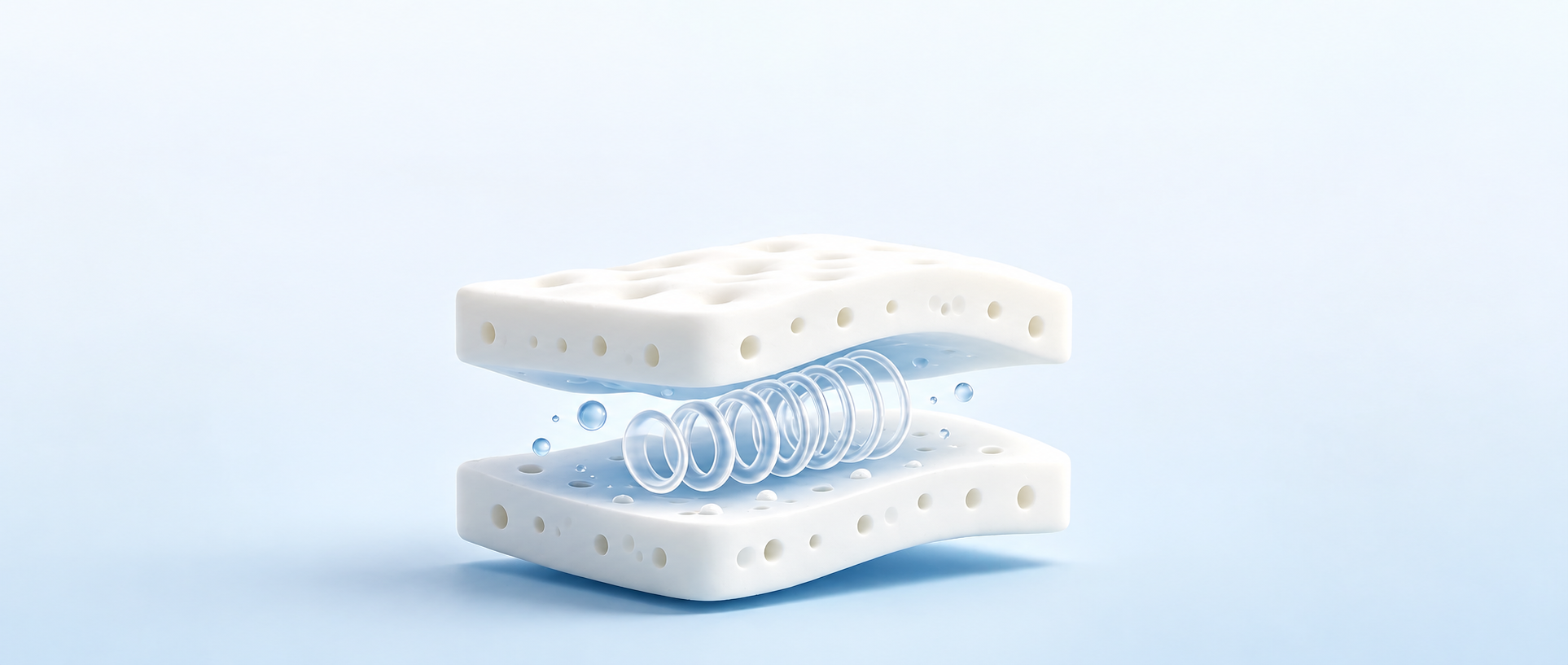
The Key Point: Flexible Foam Performance Depends on Three Balances
Adjusting flexible foam performance is fundamentally about controlling three factors: network density, soft-segment length, and the processing window.
If greater flexibility is required, longer polymer chains may be considered. If greater firmness and support are required, higher network density or reinforcement may be considered.
However, these factors should not be adjusted independently. Polyether polyol, water, and isocyanate are connected through reaction stoichiometry. Therefore, any discussion of polyol dosage should also consider the isocyanate index and the overall formulation balance.
1. Increasing Molecular Weight at the Same Functionality: Toward Softer and More Flexible Foam
When functionality remains approximately the same, increasing the molecular weight of the polyether polyol generally means longer polymer chains, longer soft segments, and a lower concentration of reactive end groups per unit mass.
Typical trends may include:
Higher elongation — longer flexible segments can generally undergo greater deformation before failure.
Softer feel and lower hardness — a less tightly connected network can provide greater flexibility.
Potential improvement in resilience and toughness — although actual resilience also depends strongly on cell structure, phase morphology, catalyst balance, formulation design, and processing conditions.
Tensile strength does not necessarily continue increasing with molecular weight — if the network becomes too loosely connected, strength and dimensional stability may eventually decrease.
In simple terms, longer chains generally help make the foam softer and more flexible, but excessively reducing network density can weaken structural support.
Selecting molecular weight is therefore a balance between flexibility, toughness, strength, and dimensional stability rather than simply choosing the highest possible molecular weight.
2. Increasing Functionality: Toward Greater Network Density and Support
Higher functionality means that each polyol molecule contains more reactive hydroxyl groups capable of participating in network formation.
When other relevant structural parameters are comparable, increasing effective functionality can increase network connectivity and crosslink density.
Typical trends may include:
Higher firmness and improved load-bearing capability.
Greater resistance to permanent deformation under compression, depending on the overall formulation and foam structure.
Lower elongation when the network becomes too restrictive, potentially increasing the risk of excessive hardness or brittleness.
However, higher functionality does not automatically mean a faster reaction.
Reaction rate depends on several factors, including hydroxyl type, primary hydroxyl content, catalyst system, temperature, and other formulation variables. Functionality primarily describes the number of reactive groups per molecule and contributes to network architecture; it should not be treated as a direct measure of reaction speed.
3. Two Additional Parameters That Should Not Be Ignored
Primary Hydroxyl Content and EO Capping
Primary hydroxyl groups are generally more reactive toward isocyanates than secondary hydroxyl groups. High-reactivity polyether polyols often use ethylene oxide capping to increase primary hydroxyl content.
This is particularly important in high-resilience and molded flexible foam systems where faster reaction development, shorter processing cycles, and appropriate demolding characteristics may be required.
EO/PO Structure
The relative amount and distribution of ethylene oxide and propylene oxide units influence properties such as hydrophilicity, polyol reactivity, phase behavior, and interactions within the polyurethane formulation.
These structural differences can also influence cell development, cell opening, resilience, and low-temperature behavior. Their effects should therefore be evaluated together with the complete foam formulation rather than as isolated parameters.
4. Formulation Balance: Why Polyol Dosage Cannot Be Considered Independently
A common question is: Can we simply add more polyether polyol?
In practice, polyol dosage cannot be considered as an isolated variable.
Polyether polyol, water, and isocyanate are connected through reaction stoichiometry. Water contributes to gas generation, polyol contributes to polymer network formation, and isocyanate reacts with both water and hydroxyl-containing components.
The isocyanate index is therefore an important formulation parameter for evaluating the relationship between available NCO groups and the reactive hydrogen components in the system.
Case 1: Relatively Low Isocyanate Index
If the effective NCO level becomes too low relative to the reactive hydrogen components, network development may become insufficient.
Depending on the formulation, possible symptoms can include softer foam, reduced mechanical strength, poor dimensional stability, or increased risk of collapse and other structural defects.
Case 2: Relatively High Isocyanate Index
If the effective NCO level is too high relative to the formulation requirements, the resulting polymer structure and hard-segment content may increase.
Depending on the system, possible effects can include increased firmness, reduced elongation, a less flexible feel, or greater brittleness.
Therefore, cracking or foam collapse should not simply be interpreted as “too much polyol.” These problems can result from an imbalance between gas generation, gel development, cell stabilization, and network strength.
Likewise, excessive hardness or poor elasticity cannot simply be explained as “too little polyol.” The underlying issue may involve network density, isocyanate index, foam density, water level, catalyst balance, or other formulation variables.
A More Practical Adjustment Approach
When Adjusting Softness and Firmness
Consider foam density, water level, isocyanate index, and polyol structure together. Polyols with suitable molecular weight and functionality can then be selected to achieve the desired balance of softness, resilience, and support.
When Adjusting Density
Water level and the overall formulation should be adjusted together. Increasing water changes both gas generation and urea formation, so density adjustment can also affect hardness, heat generation, cell structure, and foam stability.
Particular attention should be paid to the processing window associated with closed cells, shrinkage, and foam collapse.
When Increasing Load-Bearing Performance
Polymer polyols such as POP can be considered when greater load-bearing capability or firmness is required.
This approach can provide reinforcement without relying only on increasing functionality, which may otherwise make the polymer network excessively restrictive in some formulations.
A Simple Formulation Principle
First determine the target density and blowing level. Then establish an appropriate network balance and isocyanate index. Finally, select the polyether polyol structure — including molecular weight, functionality, and reactivity — according to the required foam feel and mechanical performance.
In other words:
Density and blowing level first → network balance second → polyol structure and foam feel third.
Polyether Polyol Selection Guide
Softer, More Flexible Foam with Better Elongation
At comparable functionality, consider longer-chain or lower-hydroxyl-value polyether polyols. Avoid reducing network density excessively, as this may compromise strength and dimensional stability.
Greater Firmness and Load-Bearing Capability
Higher-functionality polyols or reinforcing polymer polyols such as POP may be considered depending on the foam system. Excessive crosslink density should be avoided because it can reduce flexibility and increase brittleness.
High-Resilience Foam
High-reactivity HR polyether polyols with a high proportion of primary hydroxyl groups are commonly used in high-resilience systems. Their reactivity should be matched with the catalyst system, isocyanate, surfactant, and processing conditions.
Viscoelastic or Slow-Recovery Foam
Specialized polyether polyols designed for viscoelastic foam systems are generally used as part of a complete formulation designed to achieve the required slow-recovery behavior.
Low-Density Foam
Polyol selection should be coordinated with water level, isocyanate index, catalyst system, and surfactant system. Foam stability, cell opening, internal temperature, shrinkage, and collapse risk should all be evaluated during formulation trials.
The above information describes typical formulation trends and selection principles. Specific polyether polyol grades, formulation parameters, and dosage levels should be determined according to supplier technical data, laboratory trials, processing conditions, and actual foam performance.
Conclusion
Polyether polyols form the structural foundation of flexible polyurethane foam and play an important role in determining flexibility, firmness, resilience, processing behavior, and mechanical performance.
Molecular weight influences soft-segment length and flexibility. Functionality influences network architecture and structural support. Primary hydroxyl content and EO/PO structure influence reactivity and other formulation characteristics.
When problems such as excessive softness, excessive hardness, foam collapse, shrinkage, or cracking appear, the polyol should not be evaluated in isolation.
The more useful question is: Is the polyether polyol itself unsuitable for the required foam structure, or has the overall balance between polyol, water, isocyanate index, catalysts, surfactants, and processing conditions shifted?